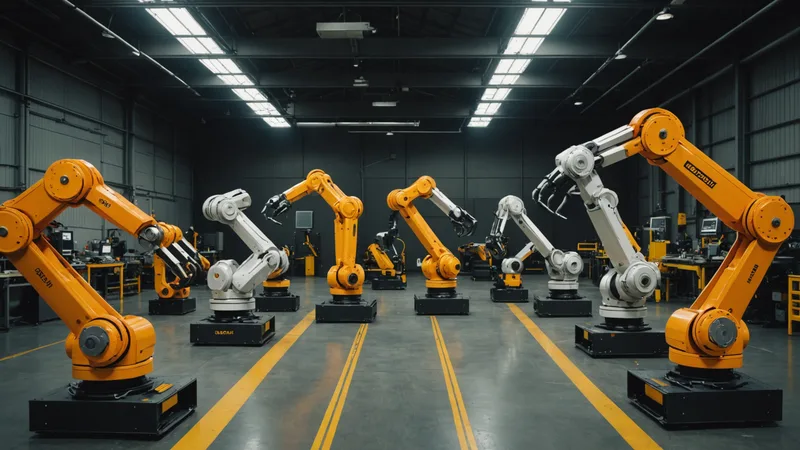
The case for robot-agnostic orchestration is sometimes framed as a technology preference argument: would you rather have a single-vendor stack or a heterogeneous one? This framing misses the actual argument, which is a structural cost argument. Factories that can substitute robot vendors without rebuilding their integration layer will have a different cost curve than factories that cannot. Over the next five years, that cost difference will accumulate and become visible in operating margins.
Here is the technical basis for that claim.
What Vendor Lock-In Costs in Automation
Vendor lock-in in industrial automation is not primarily a procurement problem. It is a maintenance and reconfiguration cost problem. When a factory has committed its integration layer to a single vendor's protocol, the integration logic sits inside that vendor's ecosystem: proprietary ladder logic, proprietary scripting languages, proprietary configuration tools. When anything in the cell changes, the integration work happens within that vendor's tools by people who know those tools.
The cost of this arrangement is low when nothing changes and the vendor's tools are familiar to the maintenance team. The cost spikes in three scenarios. First, when the vendor's product line shifts in a direction that does not align with your process requirements: new hardware requires a new controller revision, the old program needs adaptation, the adaptation requires a firmware update that breaks something else. Second, when the market produces a better option for a specific task, a cobot from a different vendor that is better suited for a human-collaborative assembly step, but integrating it means either finding a way to fit it into the existing vendor's ecosystem (sometimes possible, often not) or rebuilding part of the integration. Third, when the vendor is acquired, discontinues a product line, or shifts its pricing in a direction that changes the economics of the cell.
None of these costs appear in the original capital budget for the cell. They appear in the maintenance and operations budget over the cell's lifetime, which is typically five to ten years.
The Substitution Test
A useful way to quantify the lock-in exposure of an existing cell is the substitution test: if you needed to replace one robot in the cell with a robot from a different vendor while keeping the cell's production function identical, what would that cost? Not the hardware cost, which is relatively predictable, but the integration cost.
For a cell with a tightly coupled vendor-specific integration layer, the answer is typically: rebuild the PLC-mediated handoff logic for the new vendor's I/O protocol, rewrite the coordination scripts that referenced the old vendor's specific status words and error codes, revalidate the safety zone configuration for the new vendor's safety system, recommission the cell, and requalify the production process. In automotive-supplier contexts, where process requalification involves customer approval, the elapsed time from "we need to replace this robot" to "the cell is running again" can be six months or more. The integration work drives most of that timeline; the hardware itself ships in weeks.
For a cell with a vendor-agnostic orchestration layer, the substitution test looks different. The orchestration layer knows the old vendor's arm as a connector with a defined interface: a set of states the arm can be in, commands it accepts, and events it emits. Replacing the arm means replacing the connector, not the orchestration logic above it. The cell map stays the same. The coordination rules stay the same. The interface to the MES stays the same. Only the connector changes.
We are not saying this is cost-free. Writing a new connector for a vendor that does not have one takes real engineering time. But it is bounded engineering work on a defined interface, not open-ended rebuilding of the coordination layer.
The Mixed-Vendor Cell Is Already the Norm
There is a prior question: is single-vendor standardization actually achievable? The evidence from the cells we have worked with suggests it is increasingly not, for two reasons.
First, the robot market has stratified. Heavy industrial arms (FANUC, KUKA, ABB), collaborative robots (Universal Robots, Techman, Fanuc CRX series), and specialized machine tools (Siemens CNC systems, FANUC CNC) each have their dominant applications where they have performance or cost advantages. A cell that needs both a 200kg payload welding robot and a 10kg cobot for part presentation to a CMM is going to have two different vendors in it, because no single vendor has the optimal product at both ends of the payload spectrum.
Second, replacement cycles are asynchronous. A cell that was commissioned with KUKA robots in 2017 may replace one arm with a UR cobot in 2021 when the process changes, and then add a FANUC arm in 2023 when a new product variant requires higher throughput on one station. By the time the cell is five years old, it has three vendors in it regardless of the original intent to standardize.
The alternative, keeping the cell single-vendor by refusing to integrate new hardware, is not actually available to a plant that needs to respond to process changes and production volume shifts. The real choice is not "single-vendor vs. mixed-vendor" but "mixed-vendor with a coherent integration layer vs. mixed-vendor with accumulated custom integration debt."
Where the Cost Advantage Compounds
The structural cost advantage of robot-agnostic orchestration is not a one-time event; it is a compounding mechanism. Each time a cell modification happens, a vendor-locked integration incurs integration debt: new custom logic, new documentation describing how the custom logic works, new dependencies between the integration code and the specific controller versions in place. That debt compounds because each new modification has to navigate the existing custom logic without breaking it.
A vendor-agnostic orchestration layer breaks this compounding mechanism at the connector boundary. The orchestration logic above the connectors accumulates cell-level coordination knowledge in a form that is independent of which specific vendor is running below. When a vendor changes, the connector changes; the accumulated coordination knowledge does not need to be rebuilt.
Over a five-year horizon with typical process change rates, the difference in accumulated integration debt between a vendor-locked cell and a vendor-agnostic cell becomes a measurable labor cost difference. It also shows up in decision agility: a plant that can evaluate a new robot vendor without facing a six-month requalification cycle has more options available when the market shifts.
The Honest Constraints
This argument has real constraints that should be stated plainly. Robot-agnostic orchestration requires an upfront investment in the orchestration layer itself and in the vendor connectors for every vendor in the cell. That upfront cost is real and it precedes any of the long-term savings described above. For a single cell with a stable process and a long time horizon before any planned changes, the economics may not favor the investment.
The argument is strongest for plants with multiple cells, frequent process changes, or cells that are expected to evolve their vendor mix over their lifetime. The orchestration layer cost is fixed regardless of how many cells it covers; the integration debt savings accrue for every cell and every modification. At small scale (one or two stable cells), the case is marginal. At medium scale (four or more cells with regular process updates), it becomes compelling.
We also are not claiming that vendor-agnostic orchestration eliminates integration work entirely. It redirects it. Instead of custom per-vendor coordination code, you write connector configurations and cell maps. The connector configurations are structured, testable, and independent of the orchestration logic. That is a meaningful improvement over unstructured custom code, but it is still engineering work.
Read next: Modbus TCP on the Factory Floor in 2025: Still Everywhere, Still Annoying